Showing posts with label Daily 5. Show all posts

Saturday, October 18, 2014

Speak a WHO?

Hey, Friends! How are ya?  It’s that time! Time for another bright idea!
 
BrightIdeasButton1

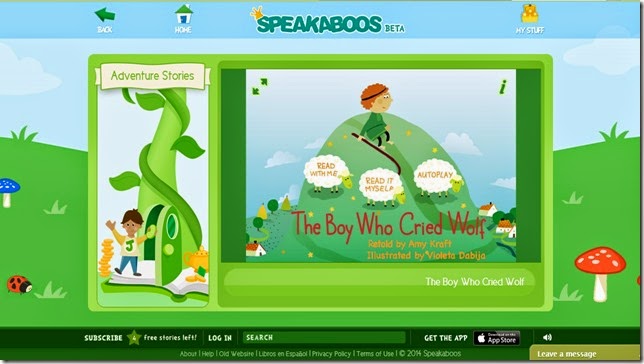
This one….has quickly become a class favorite! While searching online for an animated version of our story of the week, I came across an adorable website that couldn’t be a bit easier to use! It’s called Speakaboos. Have you ever heard of it? Speak a WHO? Speakaboos!

Slide1

If you choose, you can enter an email address to receive a FREE story each month. Free! Yep! I’ll take it! There’s also an app for THAT! Don’t want to enter your email? No worries, just close the window and move forward to the website. It’s super simple, organized wonderfully and reads “everything” as the mouse moves over the screen.

Sooooooo, you know what my kiddos asked to use as their listening station for next week, right?

Slide2

Yep! You guessed it! Speakaboos! Action stories, fairy tales, sports stories, ABCS & 123s…..students can also click the wheel at the bottom to choose animated stories by character.

Slide3

The stories can be viewed within a frame or enlarged to fit the entire screen. SUPER kid friendly, beautifully designed…..and now another little resource for you to add to your toolbox!

I hope your class will enjoy it as much as we have. Now a class favorite….the question is no longer Speak a Who? Now, it’s when CAN WE Speakaboo?! Click HERE to visit the site and check it out!

If you enjoyed this bright idea, consider joining me on Facebook, Instagram, or Twitter for more ideas to come!

For more bright ideas from a variety of other bloggers, please browse the link-up below and choose a topic/grade level that interests you. Thanks for stopping by! Happy Reading!


Saturday, September 27, 2014

Guided Reading Routines

Hi, Friends! How are ya? Ready for the weekend? Me? Oh, yeaauuuuh! It’s been a doozy of a week! The highlight? I finally got to do my favorite thing on the planet! ….work with my kids on reading! TO TEACH! The beginning of the year comes with so many “must do’s” it’s almost as if the actual teaching gets put on the back burner. Welllll, being the type of gal that prefers teaching over assessing any day…..actually getting seated at the guided reading table with a group of kids was an absolute blast!

After introducing our last area for Daily 5, it was time to dig in to the meat of why we spent the 1st 20 days building stamina to work independently.


Slide1

Last week, I promised to share a little more about our guided reading routines.  As we’re starting to build them….here’s a little peek into our 1st week!


Slide3

Our guided reading block is a solid 2 hours. Every precious minute of it is jammed packed with mini-lessons and small group activities. The wonderful thing about our schedule is having extended instructional blocks. Our daily literacy block basically flows like this……Guided Reading, then Mini-Lesson, Guided Reading, then Mini-Lesson and Guided Reading, then mini-lesson followed by independent work (if time allows). In the past I had begun with a mini-lesson…..

I chose to start with small group instead of a mini-lesson because our literacy block falls just after intervention. By doing this, I make sure not to do any new teaching of concepts before my littles who may have been pulled out return to the classroom.


Slide4

Each round begins with students “checking in”. This year, I added “teacher table” clipart to the check-in for the group that is rotating to the table to check in first.


Slide5

The first thing we do is review sight words.


Slide6

Students practice writing on a laminated sheet of paper. A whiteboard could be easily used instead. I chose to go this route because taking whiteboards in and out was a little too big and bulky for me. Last year, I used contact paper to adhere them to the table. This year, students and I are sharing the space at the table, so I’ve left them free standing. You can click HERE to grab them, if you think you’d like to use them.

After reviewing 3 sight words, students are introduced to their book for the week or begin rereading their book with prompting. The goal of this time is active processing. I want to see my students encounter challenges and observe them as they problem solve to decode words. It’s during this time that I take individual running records and make notes of student reading behaviors. It generally takes about 8 minutes or so.

After reading, we go over a quick discussion prompt that explores a comprehension strategy.

Then, one new sight word is taught. We go through the 4 activities below in order to learn this sight word. Each student has a little bin in front of them that houses magnetic letters to build the new sight word, pencils, a highlighter, expo marker and an eraser.


Slide7

Finally, we complete one of two activities. Early in the week, guided reading lessons conclude with word study. At our school, we use Wilson Fundations. It’s at this time, that we work to learn phonics patterns. During visits to the guided reading table later in the week, we complete guided writing or reading responses to deepen comprehension.


Slide8

My file cabinet sits just behind the table. On word study days, we use these cards for word building. On guided writing days, I provide an example of the graphic organizer students will complete on a small whiteboard. Because it is not used daily, I’ve attached it to file cabinet with velcro. Sticks when we need it….pulls free when we don’t! =)


Slide9

Guided writing notebooks are kept on a shelf close to the guided reading table. The label on the front of each bin indicates the name of the group…blue, purple, green or red. The symbols also correlate to the leveled readers from our series that we use for guided reading. We’ll use these journals throughout the year to complete guided writing, reading responses, and graphic organizers. They do not leave the classroom.


Slide10

Here’s an example of the graphic organizer we completed this week over sequence of events. The picture shows 3 out of my 4 reading groups. Same concept…differentiated. The first group responded by recording complete sentences from the story in the order of how they happened in the story. The second group, copied the time order words and illustrated what happened first, next and last. The final group, framed the verbs from their story’s pages and labeled each sticky note with an action from the story. That’s it! The End…ish.=)

Each rotation to the table lasts about 18 minutes…..jam packed from start to finish!


Slide11

This is the little bin I keep close at hand during guided reading. For now, it houses little pointers, magnifying glasses, pencils, bloom’s questions, LOTS of sticky notes, stickers, coding dots, pictures for vowel sorts and letter formation cards. Other things may be added as the year progresses.

What are my OTHER kids doing while I’m at the table with a small group?


Slide12

They’re checked into Daily 5. They’re moving through routines for read to self, read to someone, listen to reading, work on writing, or word work to grow as readers and writers.


Slide13

Of the 5 areas that students work on, I only have to prep materials for two of them. The first one of them is work on writing. There is one sterilite drawer at the writing table. In each of the 3 drawers is an activity to write on a given topic, focus on words, or build sentences. Each activity is complete with an I CAN statement to foster reading independence and a quick confidence boost!


Slide14

The 2nd of these areas is word work.


Slide16

Like writing, each bin houses an I CAN statement. All of the materials that students need to complete an activity are inside the bin. These activities will follow a pattern throughout the year to build students’ independence and familiarity.


Slide17

How do I motivate students to complete quality work? The simplest, easiest thing that I’ve found to motivate my students is hanging their work up for ALLLLLL to see!


Slide15

A clip up comes with having your work framed as an example for your friends to follow too!


Slide18

And how do my students feel about this time of day? Oh, just like I DO! They love it……


Slide19

Thanks for being patient as it took me a little longer than expected to get this post up! Getting ready for the week ahead? Click the pic below to grab the activities that my firsties will be working on! You can click HERE to check out my lesson plan format.

Happy guided reading, friends!


fun at school

Sunday, August 31, 2014

First Week Jitters

Hellllo……is anybody out there? Can you hear me now…OR are you coming out of a first week coma too!?? I think I might've forgotten how much work goes into the first week of first grade! Don’t laugh….BUT it reminds me of child birth. Only the labor is spread out over an entire week! My bed is still perfectly made from a week ago because I never made it to sleep in it last week! I dropped as soon as I could right onto the couch and found myself waking up there each morning. Thank God for a charged iphone battery and SEVERAL morning alarms!

fiveforfriday2_thumb[3][1]

Now that I’ve regained a little of my senses, I’m checking in with Kacey for a little Five for Friday catching up!

Slide1
With each passing day, routines and procedures began to take shape. Our first crack at building stamina lasted for a whole whopping 30 seconds! I was flipping cartwheels (in my imagination) by Friday for having built it up to a whole 7 minutes!

I usually draw our anchor charts, but with the sonshine having started his first football season the same time as school, well……ain’t nobody got time for that! Clipart spruced up our anchor chart and to keep them uniform, I’ll be printing pictures for all 5 of them.

Slide2

I did, however, whip out this little guy over a cup of yogurt Tuesday morning! This chart was definitely the class favorite of the week. We’ve learned that we can do tough stuff without quitting or giving up! There were lots of smiles as we raised our arms to flex our muscles before practicing read to self each day…

Slide3

By Friday….we had gotten to know each other a little better and were ready to be on our feet for some learning fun. We used Dr. Jean’s Rhythm rhyme to generate a list of rhyming words. These little items came from Lakeshore Learning’s rhyming basket. Each student was given an object to “hide” in their hands. When I gave them the signal “ready…rhyme” they walked around the room to find their matching rhyming partner. 

Learning on our feet? Fun!

Slide4

Later that day, we also learned how to format our math journals. The sheet of chart paper is laminated. Each day, I’ll write and wipe 4 spiral review topics for students to copy and complete in their math journals. Because this was our intro lesson….we worked through one square at a time. I covered the remaining squares with construction paper so they wouldn’t get overwhelmed. As students begin checking into math writing next week, they will work through all 4 squares at their own pace.

Introducing this activity whole group allowed  me to see who has trouble copying too. Now, I know how many students I will need to provide a copy to glue into their journal.

Slide5

….and you know that last post? The one about the room set up? How happy I was with the finished product? Perfect plan…..? Ha! You know what happened the minute the kids showed up, right? Yep! I found out what really worked and what really did not! Kids know best…..and every afternoon, I tweaked things until we got to a format that will work best for all of us.

There’ll be no riding dead horses for us. What doesn’t work, gets tweaked until it does! 

I think this one is a winner!

Lesson plans included lots of Kindergarten review and time for getting to know one another.

Today was a day of rest….tomorrow, it’ll be time to prep for week 2! As we get ready to move full speed ahead, I thought it might be a good time for a little pick me up! A little something to help get energized….How about a fun Give Away? I can’t send you a caffeine boost, but I can help with adding a little fun to those fingertips as they work to mold little firsties!

photo

The first week is a wrap! Enter below to have a little fun and win some Jamberry nail wraps from my teaching bud, Dani! 


Monday, August 11, 2014

I confess….

….I love structure! I love knowing what to expect. I love knowing what is expected of me….and why it’s important. Can I let you in on a little secret? Your students do too!

My favorite thing to teach? Literacy!!!! All day….every day! It’s the heartbeat of our classroom. If you’ve read my little blog for any period of time, you know that I’ve written several posts about my love for The Daily 5. Can I let you in on another little secret? I didn’t like it when I first heard of it! {GASP!!!} I know….. My first impression was Whaaaat?! You mean just let my kids choose what they want to do?

And then, rather than argue the point of something I really wasn’t informed about……I read the book! The more I read, the more intrigued I got. The more I read, I realized…I was already doing many of the things mentioned…just called by a different name or organized differently. What I grew to love the most was the intentional building of principled habits instead of managing student behavior.

Does your school model PBIS or CHAMPS? Again…..principled, preventative, positive habits that teach students to SELF MANAGE! Holla!!! If my students can self manage, if they can make positive choices that will impact their learning…..what’s not to like?

BUT Daily 5 is NOT balanced literacy! I KNOW! Ha!

By definition, balanced literacy is a method of teaching reading in which phonics and whole language approaches are BOTH used to maximize student learning. Bloop! That’s it…in a nutshell. 

The Daily 5 is a positive approach to classroom management that fosters literacy. Balanced Literacy is managed by Daily 5. It’s the structure…the “how to”. It’s the building of muscle memory, so you can address the components of balanced literacy with minimal interruption. The two don't compete with each other, they compliment each other.

Slide1

…and can we keep it all the way real? You simply can not teach a class that you can not manage. Building relationships and routines has to take place before you can even think of diving into teaching anything, including balanced literacy. Balanced literacy is not a new concept to early childhood teachers. It’s what we do!

In 1st grade, it may look a little like this….

Slide2

The components are all connected….

Slide3

Slide4
…and have to be interesting and FUN!

Slide5

Though the components are the same and should all be integrated, it will look a little different in each classroom because it is driven by assessment and reflecting on student needs.

Slide6

While balanced literacy will be your all encompassing umbrella, differentiation of activities for students to complete independently will allow you to meet with small groups. Getting to small group is the BIG goal of your literacy block because its at the guided reading table that the most important work begins!

Slide7

Slide8

Slide9

Ask any of my students what their favorite time of day was and they’ll gladly tell you…… “Daily 5” time. Whether you call it stations, centers or reading….what’s important is students knowing they’re working to become better readers and writers. Love structure? Yep…..I confess. I do. Love balanced literacy? Yep! I do. Would I want to teach without building principled habits? Absolutely not! Will I teach BOTH as we begin the school year? YES! 

Taking the time during those first 20 days of school to instill a classroom community that will foster successful literate kiddos is a no brainer! We’ve gotta do it, peeps! It’s honestly, what I’m looking forward to the most! And Week 5, when it all comes together is such a beautiful thing!

So the next time someone tells you Daily 5 is not balanced literacy….just smile and ask them if they’ve read the book…….it’s always a great time to learn something new.

Friday, June 20, 2014

Five for Friday~We did it!!!

Hey Friends! How are ya? Today was a great Friday! Two of my teaching besties and I presented training for the very first time! I know…yikes, right? Speaking in front of others doesn’t really bother me, but preparing to deliver training for adults is a LOT different from teaching 6 year olds! Luckily….our topic of choice was guided reading. THAT, I can talk about all day!

fiveforfriday2_thumb[3][1]

Ever find something you love and want to shout it from the rooftops for everyone to hear? Having the opportunity to present training allowed us an opportunity to do just that. We shared how implementing procedures from Jan Richardson’s The Next Step in Guided Reading enhanced our small group instruction and how we use The Daily 5 to manage our literacy block. Both have had a tremendous impact on the quality of our teaching and consequently, student success. I’ll be the first to admit that when I moved to 1st grade, my biggest fear was screwing up teaching kiddos how to read. After all, that’s what 1st grade is ALL ABOUT…..READING! I wanted someone to tell me….sit down at the table and DO THIS! Step by Step…..I signed up for training after training thinking, this will be the one! This will be the one that will guide me through this very important process and time after time…..NOPE! NADA….didn’t happen. I got exposure to great information about reading, about why it’s important and what skills I needed to address, BUT nothing that provided a step-by-step guide.

THEN…..last summer, my teaching buds and I stumbled across a book study online that was EXACTLY what we had been looking for…ordered it, read it, and improved our teaching with it! We took the next step….

Slide1

Our kids from previous years, left having become successful…but this next step helped us to understand the research behind necessary procedures and to reach personal goals for growth. The biggest part of being successful is continuous improvement and growth. Don’t ya think?

To prep for training, we set up a table to provide an example of what the guided reading table might look like when preparing for small group. LOL….the little “whiteboards” are upside down. We fixed that later…..=)

Slide2

Sharing resources was a biggie on our “to do” list. Our primary source for the information came from Jan Richardson’s website. If you’ve never visited it, you’ve gotta take an afternoon, get comfortable, sit back and browse it. She has tons of great supplemental materials to help guide the sequence of activities in your small group…differentiated lesson plans, lots of printables and video demonstrations too! Check out one of the clips we shared below…


We started the day with a fun icebreaker….I Have, Who Has….using Primer sight words! This game usually drives me a little bonkers, but is a great way to review sight words, parts of speech…you name it, and you can use it to sneak in a quick review. You also find out pretty darn quickly who’s paying attention when you play this game because each card is linked to the next, lol!

Slide4

Lots of fun and laughter...

Slide3

These ladies are the best! Having this time to engage in collaborative talk to enrich our literacy blocks was such a true gift! It was much more than training….we engaged in meaningful conversation. See those smiles? Nothing is as fun as learning in K/1!

Slide5

Here’s a closer look at the resources we shared. You can find additional information about The Daily 5 HERE. Take a few minutes and sign up for email updates from The 2 Sisters. You can find additional information and resources from The Next Step in Guided Reading HERE.

Now….summer can REALLY begin! If you’ve used these resources or another that has truly changed the way you teach guided reading, please feel free to share in the comments! 

Happy reading, friends!

Saturday, June 14, 2014

The Daily Five~Chapters 3 & 4

There are 2 things that have had a BIG impact on the way I teach over the last two years…..reading blogs and The Daily Five. I’ll never dare to teach without either of them again! After seeing so much about The Daily Five online, I absolutely had to get my hands on the book and once I did, I read it furiously with highlighter and pen in hand. It simplified my literacy block. It helped me to work smarter, not harder and NOW…….guess what?! “The Sisters” are at it again! There’s a Second Edition!!! Whoop whoop!

The Daily Five has helped me to concentrate on research based practices that have my students purposefully concentrating on actual reading rather than on the “busy work” of things that are about reading. I love it and can’t imagine going back to anything else! This week’s focus for the book study is on Chapters 3 and 4.

Jennifer at First Grade Blue Skies has an awesome freebie that outlines The 10 Steps to Teaching and Learning Independence described in Chapter 3.


Step 1:  Identify What is to Be Taught
Simple, right? Know exactly what is to be taught. This is where Independence charts come in. These are anchor charts that will outline desired behaviors and should be created together as a class. The name of the Daily 5 choice goes at the top with a side labeled for student behaviors and one labeled for teacher responsibilities. This pattern is followed for the creation of each chart.

Slide5

Step 2:  Set a Purpose and Create a Sense of Urgency
I have a very deep need to know why I  have to do something. If I don’t understand why it’s important it becomes very low on the priority list. Students are no different, they want to know why what we’re asking of them is important. By setting a purpose for what you are doing through sharing objectives in kid-friendly language, students will see the relevance of it to their daily lives.


Step3:  Record Desired Behaviors on an I-Chart
Slide2 
Be sure to discuss the desired behaviors with your class as you are creating the chart. Guide this discussion in such a way that students take ownership over the creation of it and feel their input is valid.  For young children with little stamina, only add a few at a time.


Step 4:  Model Most-Desirable Behaviors
Modeling brings everything off the written page into 3D-real life application. Be sure to emphasize what will happen if we all follow these desired behaviors. We’ll each grow to become better readers!

Step 5:  Model Least-Desirable Behaviors, Then Most-Desirable Behaviors Again
The trick to this demonstration is to call on a student who often exhibits off-task behavior. By doing this, the student is getting the desired attention he or she wants and you have an opportunity in front of a watching audience to begin shaping his or her behaviors toward meeting expectations. Genius, right?! After the student has modeled unacceptable, off task behaviors, use this same student to model desired behaviors again. This begins to build the student’s muscle memory for doing the correct thing and grows confidence that they can indeed make the right choice.

Step 6:  Place Students Around the Room
The one question that guides students choice of seating is…. “Is this a place where I and others around me can be successful”? If the answer is no, the student must choose a different spot. If the answer is yes, students are seated and begin building stamina. Next year, we will call these success spots!

Step 7:  Practice and Build Stamina
Never let a timer or clock manage children’s pace. While it is suggested to begin practicing for only 3 minutes at a time, if you are using a timer or clock…use it for your eyes only. Let your student’s behavior guide the pace of practice. Keep track of it on a chart at the meeting area to show progress. I think this may be our very first bar type graph next year! In our classroom, after we practiced building our muscle memories and began following the actual routines of Daily 5 and guided reading, we then incorporated a timer to increase our sense of urgency for completing activities.

Step 8: Stay Out of the Way
The title says it all! Your goal is to build independent learners who are intrinsically motivated. You do not want their success to be tied to you hovering over them offering thanks and praise. You want their success to be tied to an individual, self-motivated feeling of accomplishment. Stand or sit near your guided reading table or the area where you will be pulling small group as you keep a watchful eye without making eye contact with students. STAY OUT OF THE WAY….it will be hard at first, but you can do it! Winking smile Once stamina is broken…once you can tell that they’ve given you the best they’ve got, return to the meeting area in your classroom.

Step 9:  Use a Quiet Signal to Bring Students Back to the Gathering Place
As soon as students begin to show their stamina is exhausted, have them each put their book boxes away and return to your classroom gathering place. The Quiet Signal is key to beginning this transition smoothly because all students will be moving throughout the room at the same time. In our classroom we use a rain stick. Once it turns, students immediately clean up their activity, put their book box away and are seated at the carpet. I do not call them to the carpet. This too, takes time to practice and learn, but because it is a quiet signal students must be working at a reasonable noise level in order to hear it and begin the transition. This transition period also serves as a quick brain break before the beginning of the next mini-lesson.

Step 10:  Conduct a Group Check-In; Ask, “How Did it Go?”
Once students have gathered in the meeting area, develop a hand signal for students to privately respond to answer this question. Last year, we used a thumbs up or thumbs sideways over our heart to indicate how we felt about building our stamina after practicing. “The Sisters” suggested using a method of holding up a certain number of fingers in response to this question. 1 indicated below standard, 2 indicated approaching standard, 3 indicated meeting standard and 4 indicated exceeding standard.

Never scold a student for how they respond. It is, after all, their judgment of how they just performed. If it isn’t an accurate reflection, ignoring the undesired response will often cause it to stop happening. Acknowledge how well they tried and use your class’ behavior as the deciding factor for what you do next.

          Slide1 Slide3 
What I’ve enjoyed the most about the new edition is the increased flexibility of how you implement Daily 5 in response to the individual needs present in your classroom.

Below is a brief list of things you will need to begin implementing The Daily 5 in your classroom:
  • The Quiet Signal
  • Chart Rack, Easel and/or Interactive Whiteboard
  • Tools to support stamina growth
  • Individual Student Book Boxes
  • A Gathering Place for Focus Lessons
  • Independence Charts
  • Classroom Design {that allows for choices of comfortable, successful seating}
 Slide4
Taking the time to implement the focus lessons at the beginning of the year, in detail, will set your class up for success throughout the year. It takes time, but it’s worth it. It’s worth it to build independent learners who are capable of making choices. Daily 5 is not a curriculum. It is a way of managing how you present your curriculum. It is a way of providing a student driven, student inspired, student led, positive classroom environment. It compliments the workshop model for balanced literacy. It’s a way of building a life-long love of literacy and enjoyment for what has easily become our favorite time of day!

Thanks for stopping by! Don’t forget to get your copy of the book. Be sure to check in with the ladies of Freeblicious to continue the book study! All are welcome to link up! Enjoy and happy reading!


LinkWithin

Related Posts Plugin for WordPress, Blogger...